
Australian universities have invested heavily in digital platforms, but the student and staff experience has not kept pace. Here’s where the cost of fragmentation shows up, why years of digital innovation haven’t closed the gap and how it can be bridged.
It’s O-week and a student needs help with enrolment, IT support or a wellbeing query. They don’t know or care which department handles it, but even simple requests can trigger queues across multiple teams, each running their own systems and processes.
This means that context gets lost at each handoff, the student has to repeat themselves and staff spend as much time chasing updates as they do solving problems. During peak periods, these pressures compound, and the experience suffers for both the team and the student.
This experience gap usually has less to do with people or technology than most institutions think.
A university is a microcosm of a suburb
Beyond teaching and research, universities often manage parking, childcare, housing, banking, medical services, cafes, gyms and more, each with their own service catalogue and expectations.
Layer on one of the heaviest compliance environments in Australia – TEQSA, ASQA, the Department of Education, ARC, NHMRC, foreign interference obligations and more – and the operational load compounds.
Compliance obligations and costs have jumped in recent years, and that burden falls on the same finite pool of staff, students, researchers and teachers who are already stretched.
At the same time, the ground is shifting under education with growing pressure to deliver better digital experiences. Students can study from anywhere, access free certifications from global providers and technology is challenging traditional models of knowledge.
Coordination gaps are inevitable
Campus services have been built independently by departments as services, teams, systems and demands evolve. The result is a coordination problem that plays out in three familiar ways:
1
Waiting and chasing become normal.
People spend time following up rather than progressing work.
2
Context gets re-entered.
Systems don’t share the story, so a student has to explain their situation again and again.
3
Leaders face a different version of the same problem.
Work moves between teams, but ownership gets blurry and nobody is sure who is accountable.
Staff end up acting as the glue between disconnected processes. Copying details from one platform to another, playing email tag with colleagues and manually pulling information from across departments is invisible work that steals time from higher-value priorities.
Leaders face a different version of the same problem. Fragmented services reduce traceability, consistency and auditability, increasing governance and regulatory exposure at a time when compliance expectations are rising. Without a connected view of the service journey, they lack the data to improve services or make confident decisions.
International students can find this the hardest. While they bring in a significant share of university revenue, their journeys from enrolment and visa processes to fee payments and housing are often the most complex and the most fragmented.
The numbers paint a clear picture
Staff burnout, rising admin loads and students questioning their connection to campus support are all consequences of fragmented services.
The pattern extends beyond higher education. The Zendesk 2026 CX Trends Report found that 89% of Australian CX leaders believe a single unresolved service issue is enough to lose a customer for life.4
ServiceNow’s 2025 Customer Experience Report found that Australians spent 123 million hours on hold (11.1 hours per person) in the previous year, with prolonged wait times identified as the number one cause of service experience stress.5
References:
University of South Australia. Uni sector scores poor report card when it comes to workplace health, 2024
Woelert, P., Chesters, J., Martinussen, M., & Gannaway, J., Administrative burden in Australian universities: Insights into dimensions and drivers from a nationwide survey. Science and Public Policy, 2025.
QILT, Student Experience Survey National Report, 2023
Zendesk, CX Trends Report 2026
ServiceNow, Customer Experience Report: Australia, 2025
The numbers paint a clear picture
Staff burnout, rising admin loads and students questioning their connection to campus support are all consequences of fragmented services.
The pattern extends beyond higher education. The Zendesk 2026 CX Trends Report found that 89% of Australian CX leaders believe a single unresolved service issue is enough to lose a customer for life.4
ServiceNow’s 2025 Customer Experience Report found that Australians spent 123 million hours on hold (11.1 hours per person) in the previous year, with prolonged wait times identified as the number one cause of service experience stress.5
References:
University of South Australia. Uni sector scores poor report card when it comes to workplace health, 2024
Woelert, P., Chesters, J., Martinussen, M., & Gannaway, J., Administrative burden in Australian universities: Insights into dimensions and drivers from a nationwide survey. Science and Public Policy, 2025.
QILT, Student Experience Survey National Report, 2023
Zendesk, CX Trends Report 2026
ServiceNow, Customer Experience Report: Australia, 2025
Nearly
students considered leaving their studies, often citing lack of connection to campus support as a factor.3
Why digital investment hasn't closed the gap
Closing the experience gap starts with recognising it as a coordination gap. The technology, people and intent are there, and most campuses already have pockets of automation. What’s missing is the connected flow between them.
This article is part of the Closing the Campus Gap series, which also includes What connected support actually looks like and Where to find quick wins with AI.
Guide
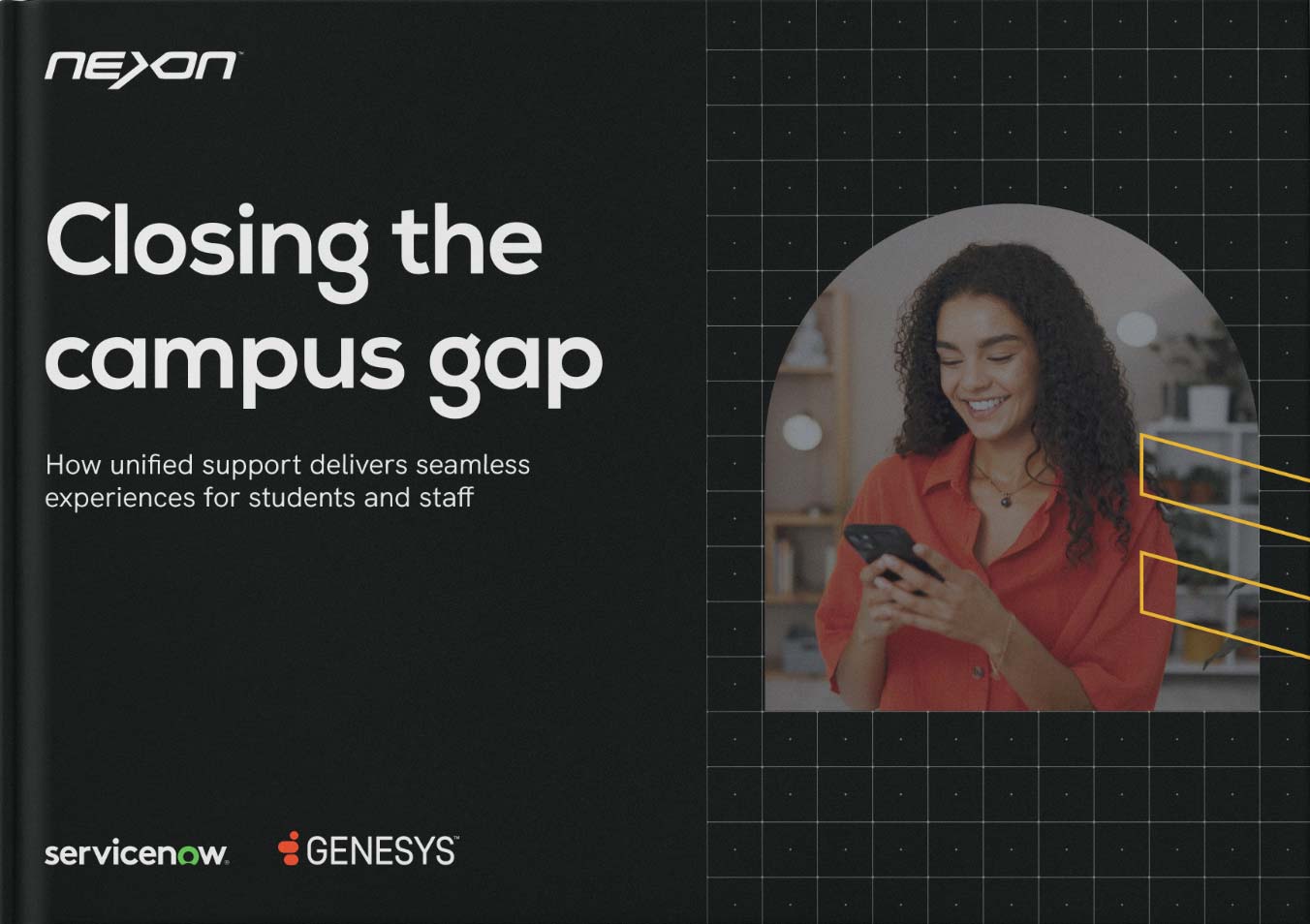
Closing the campus gap: How unified support delivers seamless experiences for students and staff
For a deeper look at the challenges and solutions explored in this series, download the guide from Nexon, Genesys and ServiceNow.
Guide
Closing the campus gap: How unified support delivers seamless experiences for students and staff
Thank you for submitting your info.
The Guide Closing the campus gap: How unified support delivers seamless experiences for students and staff download will begin shortly.
If your download doesn't start immediately, click here to download.
For more information about unified customer and employee experience for higher education, contact our team.

Anthony Gebbie is General Manager, Enterprise Digital (Public Sector) at Nexon Asia Pacific, where he leads the digital services portfolio across higher education and government.