
AI works best when it plugs into the systems and workflows you already have to reduce friction and automate routine admin to free up your staff. Here’s where to start and how to build trust as you go.
AI conversations in the higher education sector tend to start with technology questions about which copilots, chatbots or automation platforms to go with. But a better starting point is to ask where AI removes friction in the existing flow of work.
This series has looked at fragmentation in campus services and what connected support looks like. Connected workflows and clean data are the foundation for AI.
Use AI to do more with less
With limited time and money, a logical starting point is to use AI to extract more from existing systems rather than add more. In our experience, AI makes the biggest and fastest difference when it targets the three areas that consume the most time and money.
1
Automate triage and routing
Requests can be automatically classified and directed based on urgency, workload and skill, getting to the right team the first time.
2
Eliminate repetitive admin
Case notes, knowledge base updates, follow-ups and escalations can be handled automatically, freeing staff to focus on interactions that actually need a human.
3
Surface insight earlier
Too often, negative trends in service performance only become visible weeks after the fact. AI can surface patterns in real time, enabling leaders to act before small issues compound.
This also means forecasting for peak periods, such as enrolment or semester start, becomes practical rather than reactive.
Garbage in, garbage out – AI can make things worse
AI amplifies whatever you feed it. Good data produces good answers. Conflicting or outdated data produces inconsistent and wrong answers faster than ever.
Universities hold vast amounts of information, and inevitably some of it conflicts. For example, policies written by different teams can contradict each other, or knowledge base articles can sit outdated for years without anyone realising. Feed that into AI, and you won’t get hallucinations in the sense that it makes things up, but you will get different answers depending on the question.
Getting the foundations right before going live makes a real difference to accuracy and trust. AI can help with data hygiene too. Before deploying a virtual agent, it can review complex data sets, surface contradictions across policy documents and identify gaps in knowledge bases.
Treat AI like a new employee
People can go one of two ways with AI. Some don’t trust it at all, while others want to throw everything at it from the start.
We find it helps to think about AI the way you’d think about a new team member. What would you let them do on day one? Week one? Month one? You’d give them simple work with lots of support early on, and as they proved themselves, you’d give them more responsibility.
The same applies to AI. Start with specific, well-defined tasks and keep humans in the loop at every stage. Build trust through evidence and expand from there. The well-known cyber security principle of ‘verify then trust’ works just as well here.
Proof of value beats proof of concept
A proof of concept (POC) tests whether a technology works. A proof of value (POV) tests whether it delivers a real outcome for your business.
By the time you’ve navigated privacy, security and governance to run an AI pilot, you’ve done most of the work needed for production. So it’s worth structuring that test as a POV from the start, with committed resources, clear metrics and measurement of business outcomes.
While a POC can succeed and still go nowhere, a successful POV gives you evidence the business can actually use to make investment decisions. Even a POV that falls short gives you evidence. And AI is only going to get smarter, so you can revisit as capability improves.
A good starting point is to identify your highest-volume service requests, build the capability to use AI to simplify and automate those and direct everything else to existing channels.
Griffith University is putting AI to work
As covered in our previous article, Griffith University’s transformation with Nexon includes rolling out ServiceNow’s Now Assist across IT service management and customer service management functions. According to the ServiceNow case study, they expect AI to deflect up to 10% of future cases and reduce resolution times by up to 25%.¹
This article is part of the Closing the Campus Gap series, which also includes The real cost of fragmentation and What connected support actually looks like.
References:
ServiceNow Case Study, AI platform powers Griffith University’s drive for service excellence, 2025
Guide
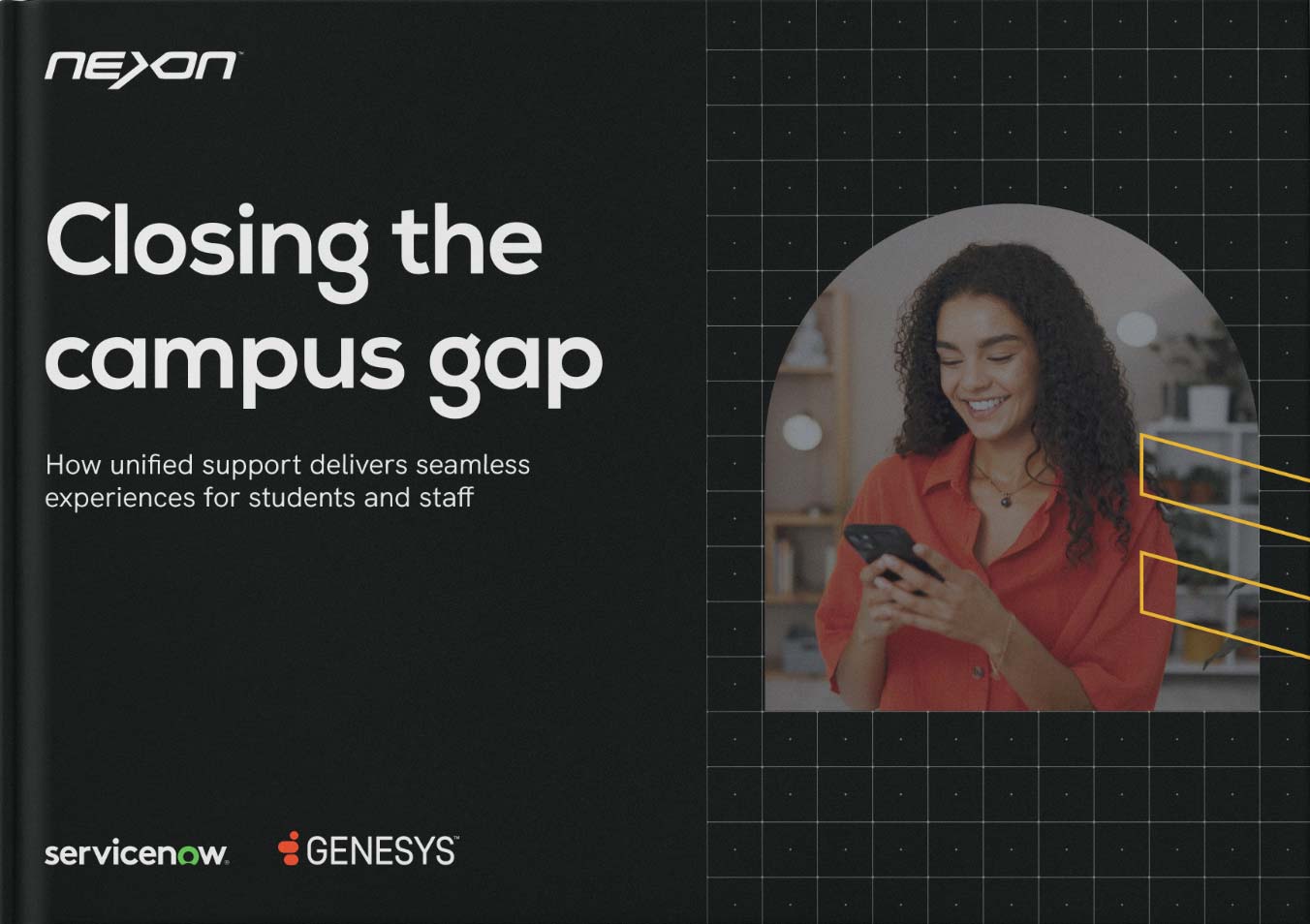
Closing the campus gap: How unified support delivers seamless experiences for students and staff
For a deeper look at the challenges and solutions explored in this series, download the guide from Nexon, Genesys and ServiceNow.
Guide
Closing the campus gap – How unified support delivers seamless experiences for students and staff
Thank you for submitting your info.
The Guide Closing the campus gap – How unified support delivers seamless experiences for students and staff download will begin shortly.
If your download doesn't start immediately, click here to download.
For more information about unified customer and employee experience for higher education, contact our team.

Anthony Gebbie is General Manager, Enterprise Digital (Public Sector) at Nexon Asia Pacific, where he leads the digital services portfolio across higher education and government.