
When service levels slip, the instinct is to invest in more people, training or tools. But before throwing more money at the problem, it’s worth auditing how requests connect and flow through existing campus systems.
The first article in this series looked at the cost of fragmentation and how the experience gap on most campuses is more of a coordination problem than a technical one. Work moves between disconnected environments and context gets lost, leaving staff to hold the system together manually.
In our experience working in tertiary education across Australia, there are almost always quick wins in shifting focus from fixing or adding individual services to connecting the flow between them.
You can’t outwork messy systems
No matter how well-trained your people are or how modern your software is, good student experience comes down to smooth workflows.
That simply means that requests are captured in detail once, directed to the right person or system and returned as an answer or solution, with clear communication along the way. It doesn’t even have to be immediate, as long as people are kept in the loop and feel heard.
The quality of that flow determines the experience for staff and students. The problem is that service requests are still being routed through a workflow that was never designed to operate as one connected system.
Five foundations for connected support
A unified model ensures that services behave as a single connected system, even when fulfilment still spans different teams. It means designing coordination into how work happens, so staff can focus on helping people instead of holding the system together.
1
One starting point for all requests
Students and staff know exactly where to go, whether it’s course advice, IT help or a facilities issue. A student changing their enrolment details can use the same channel they’d use to request tech support.

2
Connected systems, shared context
As a request moves between teams, details move with it. Students don’t have to repeat themselves, and staff have the full story – no more copying between platforms or chasing colleagues.
3
Smart routing and automation
Requests land with the right person the first time, and routine steps happen automatically. That library fine dispute goes straight to the finance team instead of bouncing between inboxes.
4
A shared view of progress
From the first request to the final resolution, every step is visible to those who need to see it. This keeps work moving and makes performance easier to track.
5
Flexibility to grow and adapt
New processes can be added and refined without breaking what’s already working. Support evolves with the needs of students and staff, across campuses and functions.
Unified support connects two essential layers
Switching between systems takes time. A unified workspace lets staff manage calls, cases, notes and next steps all in one place.
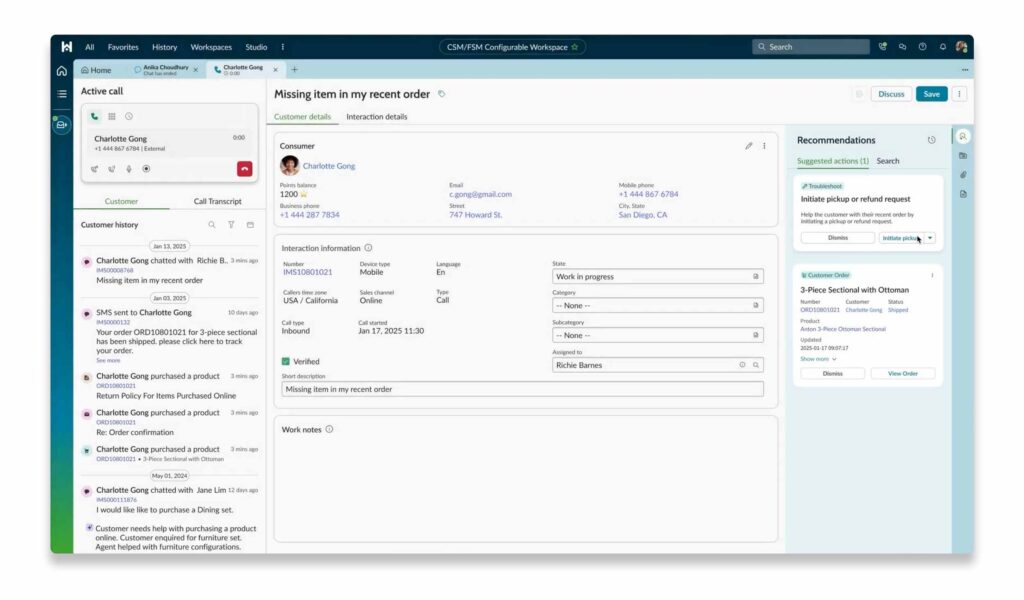
Image source: Genesys, https://www.genesys.com/en-sg/capabilities/servicenow-integration
The engagement layer
Where requests enter the system
Support requests and questions can come through live chat, phone, email, web forms or self-service search. Conversation history and context are retained, and a built-in knowledge base suggests answers in real time.
The execution layer
Where the work gets done
Each request is routed to the right team based on urgency, workload and skill. Pre-built connectors integrate with student information systems, HR, finance and IT tools so data moves automatically between them. Task status, notes and attachments sync in real time, so nobody has to re-enter details.
When these layers work together, a request can move from first contact through multiple departments without losing information. An enrolment change, a tech support issue or a financial query all follow the same structured path.
What changes when it works?

Students
Get fast, personalised support without having to repeat themselves

Staff
Spend more time helping people and less on manual admin

Leaders
Have visibility across the entire service journey, with the data they need to improve, forecast & adapt
Griffith University put this into practice
Griffith University, working with Nexon, overcame similar challenges. According to a published ServiceNow case study, the university consolidated 28 separate student portals onto a single platform with one data model. Within six months of going live, self-service rates were up 87%, first-contact resolution improved 43% and call volumes dropped 31%.¹
This article is part of the Closing the Campus Gap series, which also includes The real cost of fragmentation and Where to find quick wins with AI.
References:
ServiceNow Case Study, AI platform powers Griffith University’s drive for service excellence, 2025
Guide
Closing the campus gap: How unified support delivers seamless experiences for students and staff
For a deeper look at the challenges and solutions explored in this series, download the guide from Nexon, Genesys and ServiceNow.
Guide
Closing the campus gap — How unified support delivers seamless experiences for students and staff
Thank you for submitting your info.
The Guide Closing the campus gap — How unified support delivers seamless experiences for students and staff download will begin shortly.
If your download doesn't start immediately, click here to download.
For more information about unified customer and employee experience for higher education, contact our team.

Anthony Gebbie is General Manager, Enterprise Digital (Public Sector) at Nexon Asia Pacific, where he leads the digital services portfolio across higher education and government.