
The Australian Council for Educational Research (ACER) was founded in Melbourne in 1930 and has spent the decades since building the evidence that the world’s education systems run on.
An independent not-for-profit and official UNESCO partner, ACER has more than 400 staff across six countries. Its work reaches from a child’s first year of school through to GAMSAT, the exam that decides who gets into medicine. It also runs PISA, the study that tests the reading, maths and science skills of 15-year-olds across 100 countries.
As ACER expanded internationally throughout the 2000s, its rapid growth led to a fragmented operational structure where individual subsidiaries adopted their own local finance systems alongside various disconnected tools for project management, sales, and reporting. Ultimately creating significant complexity and a buildup of legacy data across different locations.
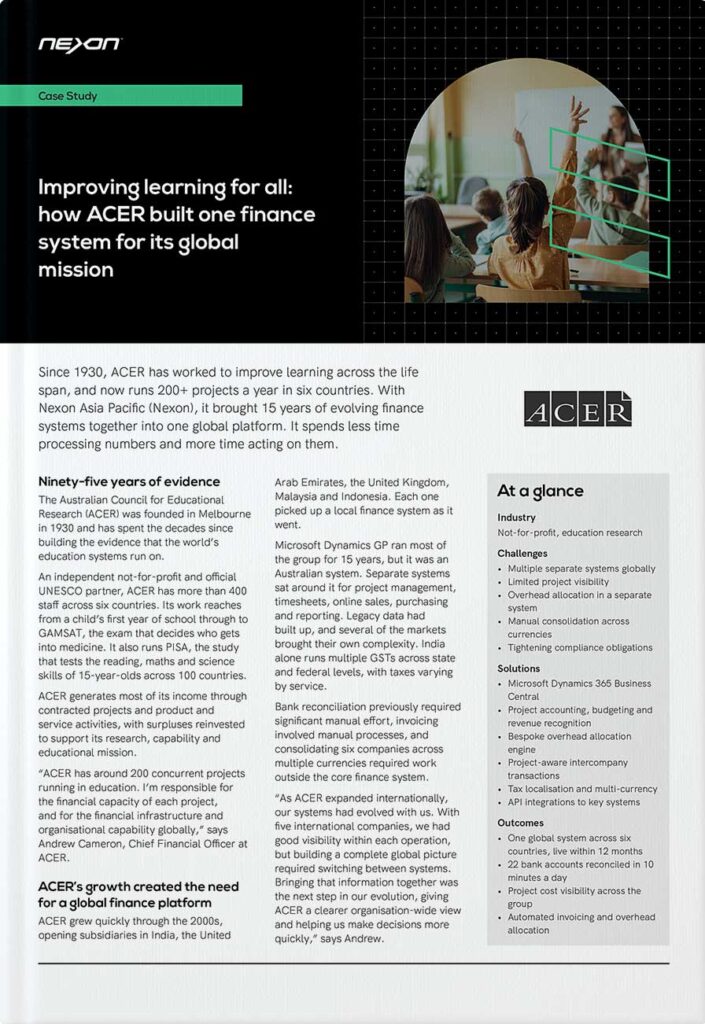
Download the complete case study
Case Study
Improving learning for all: how ACER built one finance system for its global mission
Thank you for submitting your info.
The Case Study Improving learning for all: how ACER built one finance system for its global mission download will begin shortly.
If your download doesn't start immediately, click here to download.
The challenges
- Automate overhead allocation in a separate system
- Multiple separate systems globally
- Limited project visibility
- Manual consolidation across currencies
- Tightening compliance obligations
The solutions
- Microsoft Dynamics 365 Business Central
- Project accounting, budgeting and revenue recognition
- Bespoke overhead allocation engine
- Project-aware intercompany transactions
- Tax localisation and multi-currency
- API integrations to key systems
The outcomes
- One global system across six countries, live within 12 months
- 22 bank accounts reconciled in 10 minutes a day
- Project cost visibility across the group
- Automated invoicing and overhead allocation