




How much of your technology spend is on keeping things running, versus making things better? For many mid-market organisations, the majority goes to maintenance, vendor management and problem fixing, with residual funds for innovation or building new capability.
It’s an invisible line item in the budget that accumulates quietly – in the time spent coordinating between vendors, making do with aging systems and using workarounds that have become standard practice.
Death by a hundred apps
The average organisation now uses more than 100 different software applications.* Each brings its own contracts, support channels, dashboards and upgrade cycles.
“One of the areas where we see organisations bleed money is obsolete technology sitting in the background,” says Josh Sampson, Solutions Architect at Nexon.
“They haven’t looked at it in years, people aren’t using it and it’s not providing the appropriate amount of business value.”
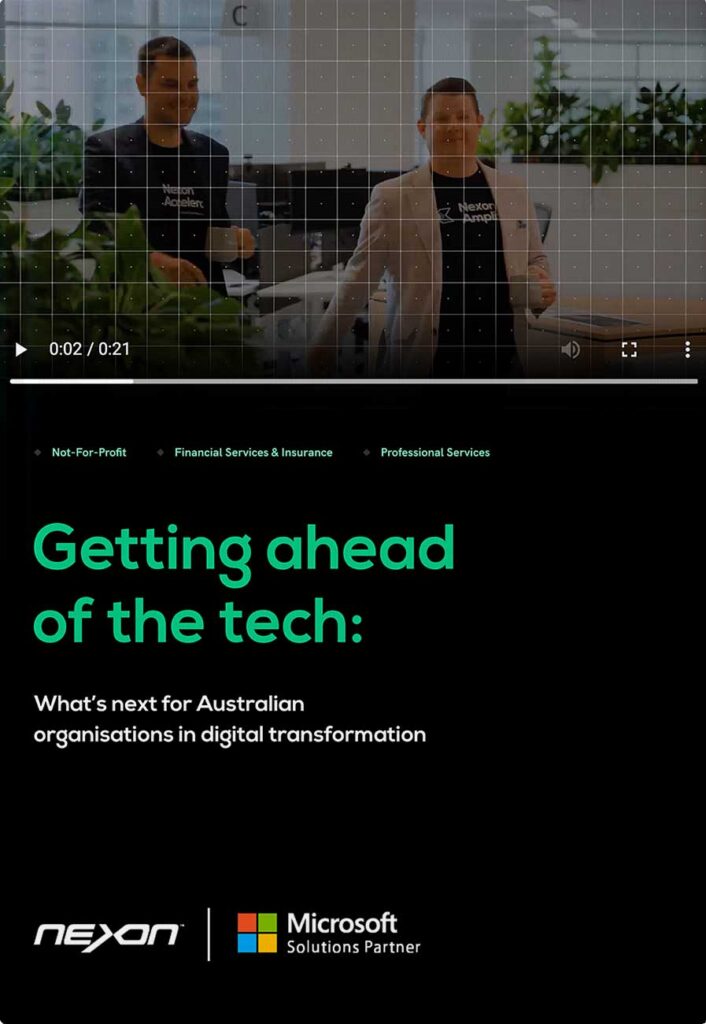
See Elliot and Josh discuss how organisations are overcoming IT complexity in our fireside chat.
Flick Anticimex: National consolidation creates capacity for growth
Flick Anticimex (Flick) is a leading pest control and hygiene brand with a strong presence across Australia and New Zealand. However, Flick’s management understood that its legacy IT infrastructure was not fit-for-purpose as the company sought to achieve significant business growth.
Being overly reliant on on-premise servers housed in a variety of data centres, its operations were being constrained and it was beginning to risk being unable to deliver the exceptional experiences that customers had come to expect from their brand. A substantial digital transformation was required to ensure Flick had the right foundations to grow and to continue serving customers into the future.
Commencing operations in 1918, Flick has over 780 technicians servicing over 300,000 customer sites annually. Flick protects over 55,000 commercial sites and 180,000 residential customers from pests every year. However, Flick management was realising that its ability to make additional acquisitions and surpass changing customer expectations, including the transition to a managed services business model, was being hampered by its legacy IT infrastructure.
Nexon’s methodology was to deliver a holistic end-to-end technology solution for Flick that always placed Flick’s business goals at the centre of the scope of works. Certainly, it was important that the technologies chosen were best-of-breed, but equally important was Nexon’s commitment to delivering outcomes with care and in full collaboration with Flick. For example, the migration from an on-premise legacy system to a cloud-based system required careful planning and coordination in order to avoid any unnecessary business disruption that would impact Flick’s customers.
Craveable Brands: Predictable costs across 600 locations
Craveable Brands As one of Australia’s leading food franchisors, Craveable owns four loved Australian brands: Red Rooster, Oporto, Chicken Treat and Chargrill Charlie’s. Its franchise network supports over 400 small business owners and serves over 1 million customers weekly through a workforce of 13,000+ people.
When it came time to upgrade its technology foundation, Craveable chose to renew and strengthen its partnership with Nexon Asia Pacific and Cisco Meraki after a highly competitive tender process.
The goal: To provide fast, reliable and secure networking to power everything from online orders to drive-through innovation, supporting their franchisees to efficiently deliver exceptional customer experiences.
With a modern technology foundation, Craveable is well-positioned to support its ambitious growth plans and digital innovation initiatives across its 600+ franchise locations.
“We’re delivering new switches, access points, cables, service improvements and better speed, security and reliability – all for the same price as five years ago,” says Simon Revelman, CIO of Craveable Brands. “Now, we have predictable costs and simplified billing across all locations.”
The case for consolidation
An end-to-end managed services model brings cloud, network, security and user experience under one provider – with unified visibility, fewer support channels and transparent pricing.
“Most organisations are simply too busy running their own operations to keep up with the speed of change – particularly in cloud and AI,” says Jurd. “This is where having the right partner matters – a technology partner who lives and breathes it every day.”
For many organisations, the opportunity is to spend differently, not spend more.
As a Microsoft Solutions Partner with specialisations across cloud, security, data and AI, Nexon delivers end-to-end managed services that help organisations consolidate complexity and build capability for the future.
View the eBook: Getting ahead of the tech
A practical guide to how Australian organisations are simplifying their technology environments, reducing operational overhead and building capability for the future.
eBook
Getting ahead of the tech: What’s next for Australian organisations in digital transformation
Thank you for submitting your info.
The eBook Getting ahead of the tech: What’s next for Australian organisations in digital transformation download will begin shortly.
If your download doesn't start immediately, click here to download.
For a no-obligation discussion about our end-to-end managed services contact Nexon today.
Elliot Jurd is General Manager Cloud at Nexon Asia Pacific
Josh Sampson is Solutions Architect at Nexon Asia Pacific
References:
Better Cloud: 140 SaaS statistics for 2025
More articles to explore