




While every technology shift creates winners and losers, AI is creating them faster than any before it. The gap between haves and have-nots is widening, but this time it may not close.
BlackBerry. Myspace. Pets.com. The first wave of a technology revolution burns through billions before the long-term winners emerge. AI is following the same pattern, just at twice the speed.
The market was right about the internet in the long term but spectacularly wrong in the short term. The same applies to AI, compressed into a fraction of the time. Most of the winning companies from this era haven’t been built yet.
What's different this time is the speed
“The internet boom played out over roughly two decades before things settled. I believe the AI cycle will compress that into five or ten years. The same creation and destruction of industries, at twice the speed,” says Elliot Jurd, General Manager – Cloud at Nexon Asia Pacific.
Leaders are already asking what their business will be worth in two or three years, how defensible their operating model really is and what happens when a competitor delivers the same service at a fraction of the cost. SaaS valuations are compressing because investors can’t confidently project how durable these business models will be as AI matures. Smart customers are questioning the length of supplier contracts because the cost of delivering services may look fundamentally different within two years.
We know change is coming, but not the shape it will take.
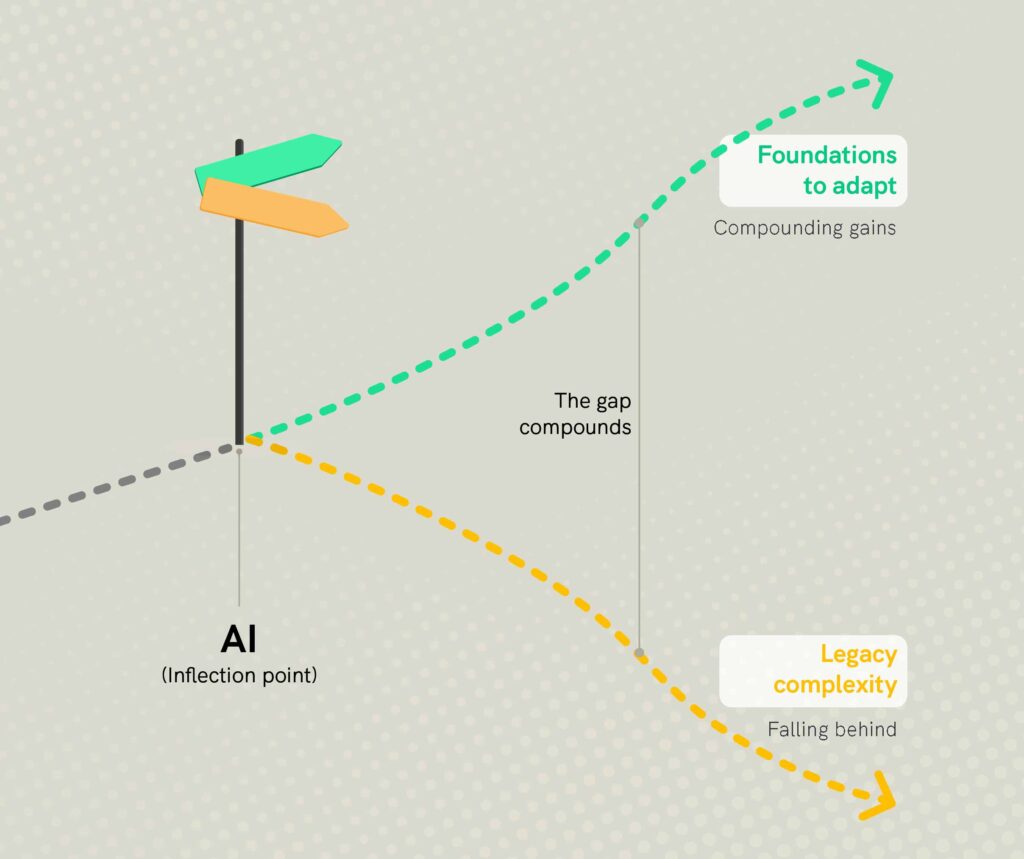
The K-Curve: the widening gap between AI-ready organisations and those weighed down by legacy complexity
A widening gap with no correction
The K-Curve was popularised during COVID, when economists described a K-shaped recovery – asset-rich knowledge workers thrived while service and hourly workers fell behind. The two arms of the K diverged from a single point, and the gap compounded over time.
The same dynamic is forming around AI.
Organisations embedding AI into their operations – from infrastructure and service delivery to data-driven decisions – are seeing compounding productivity gains: structural improvements to cost, speed and capability that accelerate year on year. Organisations treating AI as a side project, waiting for it to mature, or moving slowly because of legacy technology, are falling behind.
Unlike previous technology shifts like e-commerce, mobile and cloud, where most organisations eventually caught up, this gap is likely to compound over time rather than correct.
Whether it’s your career, department, business or industry, the ground is shifting. Which side of the K will you land on?
Ambition is running ahead of capability
Most Australian organisations feel the urgency and are experimenting with AI in some form. But there’s a gulf between activity and impact.
74% of senior leaders want AI to drive revenue growth. Only 20% have seen it happen.
That’s from Deloitte’s 2026 State of AI in the Enterprise report, surveying more than 3,200 senior leaders. 66% of organisations report productivity gains from AI, yet only 16% have rewired their existing roles or workflows for it.1
The gap between ambition and outcome comes down to the infrastructure underneath.
Most organisations have assembled their technology environment one decision and one department at a time. A decade of those decisions leaves a hybrid environment that nobody designed as a whole. While this has largely been manageable, AI quickly exposes the cracks.
The race rewards those ready, not those first
The best ships haven’t sailed yet. The real opportunities from AI are still forming, and the organisations that capture them will be the ones with the right platform underneath.
The infrastructure decisions being made now will determine who can move when the right opportunity arrives.
Your foundations will determine which side of the divide you land on.
Download the guide from Nexon and HPE:
In AI, we're at 1996. Slow down, or you'll miss the boat.
Inside: what AI readiness actually looks like, and the four foundations that separate the organisations pulling ahead from those falling behind.
Whitepaper
In AI, we’re at 1996; Slow down, or you’ll miss the boat
Thank you for submitting your info.
The Whitepaper In AI, we’re at 1996; Slow down, or you’ll miss the boat download will begin shortly.
If your download doesn't start immediately, click here to download.
To help find out where you stand, Nexon’s hybrid cloud assessment maps your current environment, identifies gaps and outlines a practical path to an AI-ready platform.
For more information about assessing your AI readiness and hybrid cloud foundations, contact us.
Elliot Jurd is General Manager Cloud at Nexon Asia Pacific
Garth Sperring is General Manager – Network & Cyber, at Nexon Asia Pacific
References:
Deloitte AI Institute, State of AI in the Enterprise (survey of 3,235 leaders), 2026
More articles to explore