
An Enterprise Resource Planning (ERP) transformation should make your organisation easier to run, not introduce unnecessary complexity.
Yet one of the biggest challenges during an ERP implementation plan is agreeing on what the initial solution should include. Build too little, and the system may not deliver the operational efficiency you need. Build too much, and users can be left navigating an overengineered solution that’s difficult to adopt.
Moving beyond basic financial management
A simple ERP structure may only capture general ledger accounts and financial dimensions. While this provides greater control than spreadsheets, it remains largely focused on recording and reviewing past financial activity.
Adding customer, vendor, and item subledgers gives the organisation more visibility. However, the solution may still fall short of actively supporting forecasting, scheduling, resource allocation, and operational decision-making.
This is where an experienced ERP implementation partner becomes important. The right advice can help stakeholders determine the appropriate ERP implementation strategy, identify which capabilities are genuinely required for the first release and which should be introduced later.
Defining the right level of ERP capability
A well-designed minimum viable product (MVP) should provide enough capability to improve how the organisation operates without trying to solve every future requirement from day one.
For example, using the Projects or Jobs module in Microsoft Dynamics 365 Business Central can support forecasting, commitment accounting, profitability analysis, utilisation reporting, timesheets, work in progress, and revenue recognition. It can also bring labour, inventory, services, customers, and billing together within a coordinated schedule.
This creates a strong operational foundation while allowing the ERP system implementation to evolve over time.
An effective implementation needs the right level of detail. I visualise four levels of target capability:
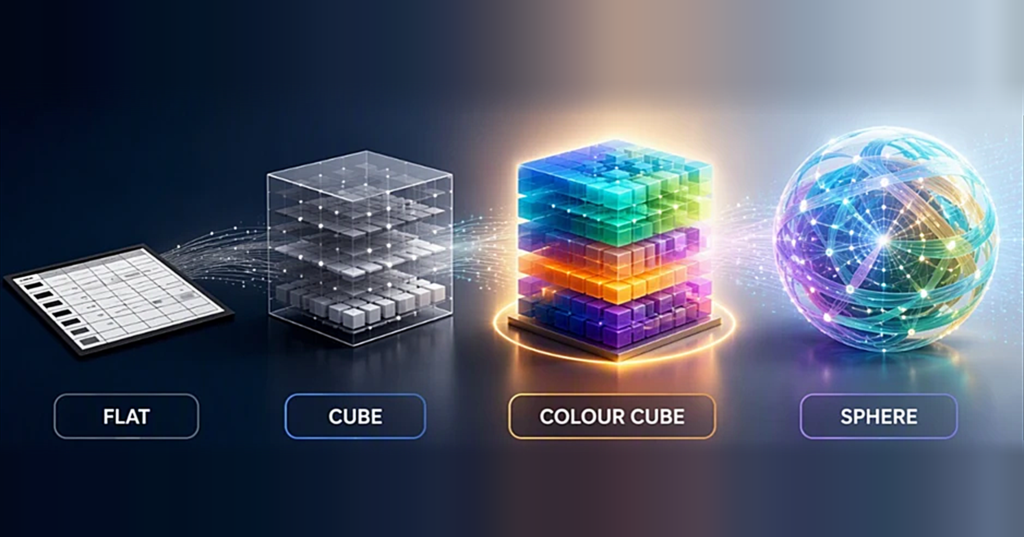
Four levels of ERP implementation complexity – from flat structures to integrated analytics. The colour cube represents a balanced MVP, with subsequent phases progressing towards the sphere.
One way to think about this is through four levels of capability.
1. G/L–Flat: The simplest model is a black-and-white, two-dimensional structure, with General Ledger (G/L) accounts as rows and Financial Dimensions (Dims) as columns. Although more capable than an abacus or multiple Excel spreadsheets, it reflects a Financial Management Information System (FMIS) and traditional bookkeeping approach: a retrospective reflection of financial events rather than active operational management.
2. Subledgers
The first step beyond a General Ledger is introducing subledgers for areas such as vendors, customers, and inventory. In Microsoft Dynamics 365 Business Central, for example, Vendor Ledger Entries, Customer Ledger Entries, and Item Ledger Entries provide the transactional detail beneath the G/L. This helps finance teams understand what sits behind an account balance, rather than relying solely on financial dimensions and summary-level reporting.
3. Advanced subledgers
The next step introduces operational structures such as Projects and the Asset Tree. This is where the platform begins to behave as a true ERP rather than primarily a financial management system. Projects can bring together resources, items, customers, billing, timesheets, and schedules, while supporting forecasting, commitment accounting, profitability analysis, utilisation, Work in Progress, cost recognition, and revenue recognition. For many organisations, this represents a practical MVP. It provides the operational capability needed to manage the business today without introducing every possible integration or analytical layer from day one. It supports accountants and controllers with forecasting, scheduling, profitability analysis and efficiency measurement capabilities that go well beyond transactional bookkeeping.
4. Integrated analytics, Dataverse, and Fabric
Once the ERP foundation is established, organisations can extend it by connecting operational and analytical platforms. For example, integrating Dynamics 365 Business Central with Dynamics 365 Field Service through Microsoft Dataverse can enable coupled master data and reconciliation across systems. Adding Microsoft Fabric can then create another layer for integrated data and analytics. This is a post-MVP phase that uses contemporary tools to support a sophisticated, holistic solution. It is particularly relevant to a Systems Accountant working across integrated platforms.
Choosing the right level of complexity
Although this model is an abstract representation, it has practical implications. One example is the choice in Microsoft Dynamics 365 Business Central (D365 BC) between using the full Projects/Jobs module (as a container for inbound Costs and outbound Revenues) and representing a project only as a Financial Dimension.
Using the Projects/Jobs module within the colour-cube model provides:
- planned forecasts and expectations;
- commitment accounting;
- marginal analysis for profitability, and efficiency analysis for utilisation;
- the ability to combine resources (labour), items (inventory, consumables and services), customers and billing within a scheduled timeline;
- option to recognise Timesheets;
- calculation of required outcomes from operational data, including Work in Progress (WIP), cost recognition and revenue recognition; and
- flexible task assignment and allocation.
Extending the model to a sphere by combining Projects in D365 BC with associated Work Orders in Dynamics 365 Field Service (D365 FS) adds:
- Coupled Master Data through Dataverse;
- reconciliation of subledgers across systems and environments; and
- combined data queries with multilayered structures and indirect conditional filters.
This is where ERP transformation moves beyond recording and managing transactions towards creating a more connected view of financial and operational performance.
More functionality isn’t always harder
The important point is that less functionality doesn’t automatically mean a better ERP implementation. Effective ERP implementation services helps determine where that MVP should sit based on business processes, reporting requirements, integration needs, user adoption, and the organisation’s longer-term roadmap. There is a perception that when the product is enriched with more functional modules, its becoming harder to implement, However, this is proven to be wrong by the successful implementations.
An experienced ERP implementation partner should help you get that balance right, delivering enough capability to create value now while designing the architecture to support what comes next.
Planning for the next stage
Once the core platform is working effectively, organisations can introduce integrated analytics, Dataverse, Microsoft Fabric, field service capabilities, and connected data structures.
Combining Business Central Projects with Dynamics 365 Field Service, for instance, can support shared master data, reconciliation across systems, and more sophisticated data analysis.
The key is choosing an ERP implementation partner that understands both your immediate operational needs and your longer-term transformation goals. There are no wrong choices, but organisations should make informed decisions that accommodate the inevitable progression of ERP digital transformation.
Planning your ERP transformation
Our ERP implementation services help organisations define the right level of complexity, establish a practical ERP implementation plan, and build a platform that can evolve with the business.
Reach out to understand how we can provide ERP consulting and support your ERP transformation.

Progressing from fragmented components to a coherent, structured ERP solution.
There are no wrong choices, but I would like you to have an aware decision and accommodate inevitable progress with ERP digital transformation

Dr Andrew Sknar is Principal Solution Architect ERP at Nexon Asia Pacific